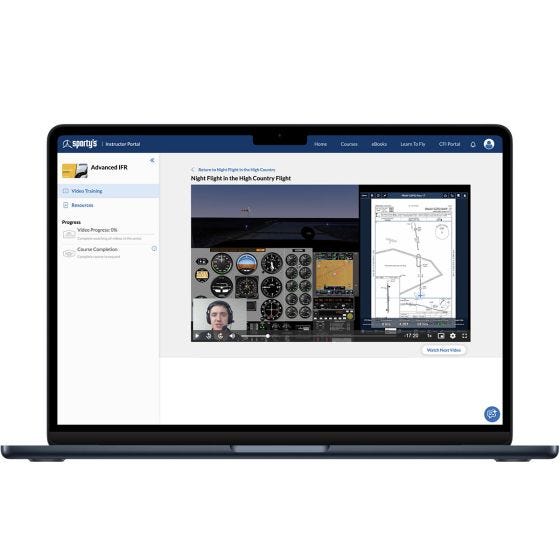
Advanced IFR Course (PilotWorkshops)
In stock
Backordered
Start Using the Full Power of the IFR System
Perfect for student pilots and weekend warriors, this bag was designed around the beginning pilot. Enough space for a headset and books, yet small enough to not throw off your weight and balance. The most important feature students wanted: price. You shouldn’t have to take out a second mortgage to get a high quality, custom built flight bag.
This bag is loaded with custom pockets designed to all your gear. A padded headset pocket is large enough to fit most headsets without their case. A small slash pocket on the exterior of the headset pocket is perfect for a flashlight or fuel tester. The other end of the bag has a radio pocket for your backup hand-held transceiver and an expandable pocket for a water bottle. The front pocket is generously sized to fit most logbooks and has an organizer for pens and business cards.
- Tower Enroute Control (TEC) Routes
- Diverse Vector Areas at Non-towered Airports
- Custom Waypoints in a GPS Flight Plan (under IFR)
- Graphical ODPs
- Complex Textual ODPs
- Departing No-IAP Airports
- Diverse Departures
- Standard Instrument Departures (SIDs)
- Published Visual Climbs Over Airport (VCOA)
- Best Practices For Negotiating With ATC
- Vertical Navigation With GPS and Autopilot
- Traps With Unpublished Descent Gradients
- Standard Terminal Arrivals (STARs)
- Cold Temperature Restrictions
- Contact Approaches
- Radius-to-fix (RF) Legs On Approaches
- Hybrid GPS-Localizer Approaches
- Circling Approach Survival Secrets/li>
- GPS Use On Localizer Back Courses/li>
- Localizer Directional Aids (The “other” ILS)
- Taxi Hot Spots
- And more…
Course Overview
You don’t need an Instrument Rating to understand the simplified concepts Ryan teaches in this course. The focus is purely on VFR flying. He “borrows” specific habits and techniques from IFR flying and shows you how to use them for additional protection, situational awareness, comfort, and control when flying VFR.
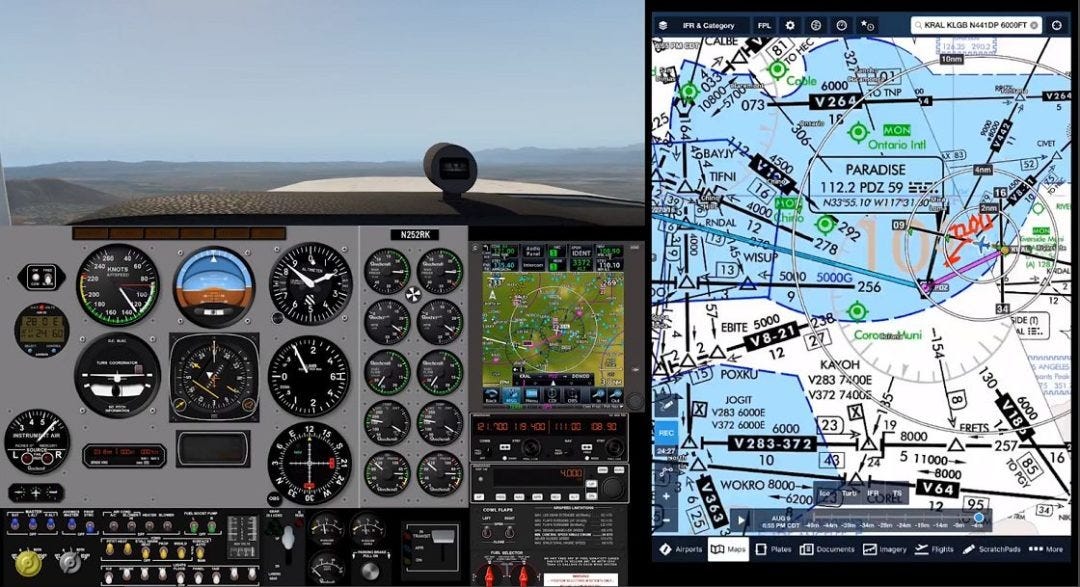
Flight 1: "A Short, Busy Trip"
From/To: Riverside, CA (KRAL) – Long Beach, CA (KLGB)
Briefing: 12 min
Flight: 23 min
Debrief: 2 min
Planning is essential for IFR flight in the L.A. Basin, especially when ATC expects you to have all the insider information. This includes finding the right Tower Enroute Control route and filing that code in your flight plan. It might also include an ODP assigned by ATC for traffic flow that you’re required to fly. Ryan lightens the load by backing up visual navigation (but still under IFR) with published approaches and visual tools built into the Garmin GTN navigator. But then he uncovers an easy trap for the complacent when prioritizing tasks in a busy terminal environment.
Key Items: Tower Enroute Control route, assigned ODP, ForeFlight route advisor, GTN visual approach function, flight instrument checks, flowchecks and checklists, busy terminal environment, automation traps.
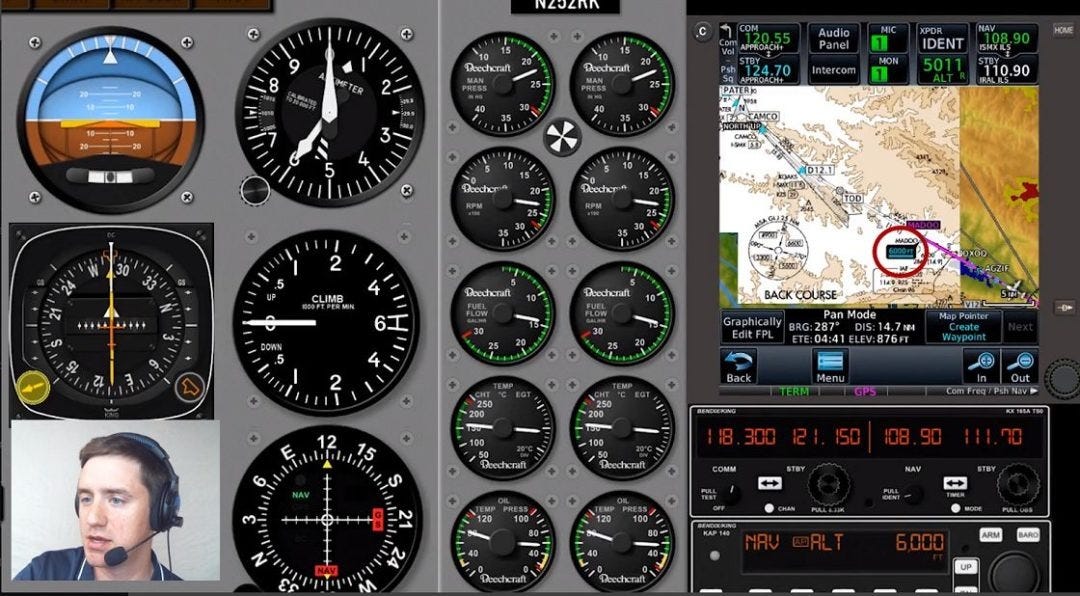
Flight 2: "Maximizing the GPS"
From/To: Long Beach, CA (KLGB) – Santa Maria, CA (KSMX)
Briefing: 14 min
Flight: 28 min
Debrief: 2 min
This trip starts with tips for complex taxi instructions and using published runway hot spots, along with annotating a chart in ForeFlight. The departure includes an RNAV SID, which requires understanding the buttonology, limitations, and legalities of the GPS. SID instructions and amendments get covered. On the arrival side, the GPS is used for descent planning on a steep approach with stepdowns inside the final approach fix, as well as the legalities and practicalities of GPS for a localizer backcourse. A missed approach reveals a trick to fly a missed approach hold while simultaneously loading the next approach, all with only one GPS. Use syn vis and terrain screens to keep track of where the hills lurk.
Key Items: Hot spots, climb via SID, back course guidance, estimating unpublished descent gradients, syn vis, terrain, flight plan editing
Flight 3: "Short-Field to Class C"
From/To: Oceano, CA (L52) – Monterey, CA (KMRY)
Briefing: 16 min
Flight: 25 min
Debrief: 2 min
Departing an airport without any published instrument procedures is made simpler and safer using the VFR sectional and a smart roll-your-own departure. The ForeFlight route advisor is helpful, but it’s better when you understand the ATC system for routings. (Hint: It’s not always about your departure and destination airports.) Planning also includes customizing the published VDP for your specific aircraft and customizing the VNAV profiles in the GPS for smart use of the autopilot (including the confusing VNAV Direct). Even with all that automation, Ryan demonstrates how some mental math acts as a backup and check that you pushed all the buttons correctly.
Key items: Departures from non-instrument airports, departure alternates, LP approaches with unofficial vertical guidance, adjusting the published VDP, customizing VNAV profiles
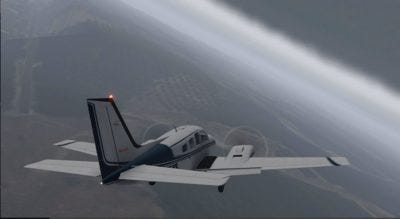
Flight 4: "Busy Airports and New-School Approaches"
From/To: Fullerton, CA (KFUL) – Santa Ana, CA (KSNA)
Briefing: 10 min
Flight: 23 min
Debrief: 2 min
We use old school techniques and new technology to navigate this highly congested airspace. First, we follow the freeway east after takeoff, then get turned direct after contacting departure. We use a few GPS tricks enroute for situational awareness, and have to manage an ATC frequency that is humming with activity. Finally, we are rewarded with an uneventful arrival to the Class C airport.
Key items: Non-standard diverse vector areas, RF leg, hybrid approaches (GPS/ILS), best forward speed, picking the best minimums, negotiating with ATC, legally using an expired database, autopilot tricks, digital ATIS
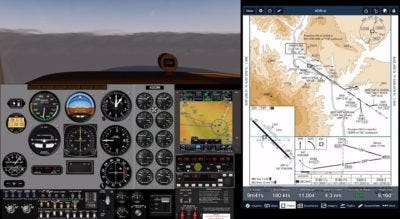
Flight 5: "Departure Traps and Non-Precision Approach Tricks"
From/To: Origin – Destination
Briefing: 17 min
Flight: 27 min
Debrief: 2 min
Many pilots avoid flying over, under, through—or even near—Class Bravo airspace. But often the best destinations are near these busy terminal areas. Here, we review the Flyway charts for the Los Angeles area and show you how published transitions can make transiting these areas easier and less stressful.
Key items: Calling ATC on the phone, decline a shortcut, cryptic approach clearances, non-standard climbs, textual ODP tips and traps, cold temp restrictions, mystery paths to IAFs, dead reckoning legs, best rules for circling
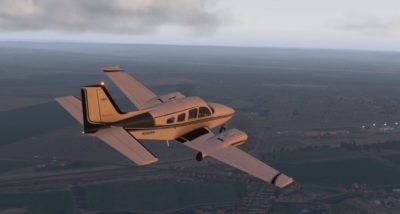
Flight 6: "Belt and Suspenders (GPS + VORs + Eyeballs)"
From/To: Santa Ana, CA (KSNA) – Burbank, CA (KBUR)
Briefing: 10 min
Flight: 19 min
Debrief: 2 min
This flight is a handful from takeoff until engine shut down. Departing a busy Class C airport, following vectors and then using radials to follow the published transition over LAX, monitoring busy radio frequencies, and finally landing at Burbank. Just another day flying in the LA basin.
Key items: Planning backups for GPS, graphical ODPs, simplified climb gradient planning, ForeFlight performance planning, creating custom holds in the GPS, loading airways, contact approach requests and best practices
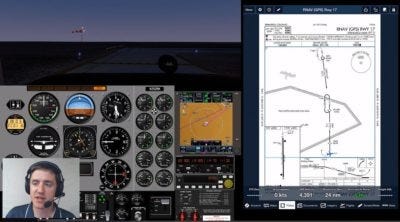
Flight 7: "Night Flight in the High Country"
From/To: Springfield, CO (8V7) – Denver, CO (KAPA)
Briefing: 12 min
Flight: 21 min
Debrief: 2 min
The diverse departure gives flexibility but nearby military airspace restricts it. Putting a custom waypoint by radial/distance from a VOR into the flightplan, the GPS, and ForeFlight makes things simple. The arrival into the Denver area brings STARs into the picture with potential descend via clearances, and the proximity of terrain at night means synthetic vision, profile views, and terrain overlays come into play. Loading vectors to final is fine on a GTN, but there are still tricks to be used when on vectors that let you almost read ATC’s mind.
Key items: Custom radial/distance waypoints, diverse departures, planning around SUAs, selecting STARs, descend via clearances, sidestep approach procedures, terrain awareness, high-speed approach
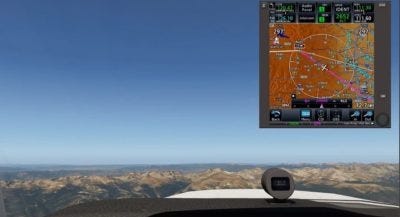
Flight 8: "Multiple Crossings, Steep Descents, and High True Airspeed"
From/To: Denver, CO (KAPA) – Eagle, CO (KEGE)
Briefing: 9 min
Flight: 17 min
Debrief: 2 min
How do you pick the right SID when there’s more than a page worth? ForeFlight can be a huge help if you know where to look. How can you descend below DA even when the airport isn’t in sight? It can happen with a fly visual segment, but you’d better understand what that means for a missed approach. This trip requires multiple stepdowns with multiple nav sources, and even with a good autopilot, it’s easy to fall behind.
Key items: Picking a SID, LDA with a glideslope, legal descent below the DA, arrival holds, alternate missed approach, automation gotchas, discrepancies between GPS and VOR courses, steep descents and high TAS
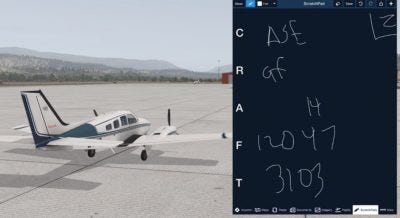
Flight 9: "Hurry to the Most Challenging U.S. Approach"
From/To: Eagle, CO (KEGE) – Aspen, CO (KASE)
Briefing: 12 min
Flight: 17 min
Debrief: 2 min
Sometimes the only way out is the Visual Climb Over the Airport, which happens here before a rush to get established on the notorious localizer into Aspen—which requires over twice the descent rate of a typical instrument approach. This means adjusting standard performance profiles in anticipation of the anvil descent, yet having a workable backup plan in case you don’t quite get down. Once you commit at Aspen, the complex missed approach is no longer an option.
Key items: Ruling out SIDs, visual climb over airport (VCOA), the notorious Aspen localizer approach, altering performances profiles, unusual missed approach, circling in the mountains, intercepting VOR radials with GPS
Meet Your Instructor
Ryan Koch
CFII, Director of Product Development
Ryan is responsible for the design and development of our new online training courses and pilot-friendly manuals, and oversees the course development team. He is also an active flight instructor specializing in instrument flight, is a flight simulator expert, and has experience doing remote flight instruction via simulators.
Ryan was the driving force behind the development of several PilotWorkshops online courses, including Instrument Rating Accelerator, IFR: The Missing Lessons, Garmin GTN: Next Level, and Advanced IFR. Ryan is also a contributing expert for PilotWorkshops’ IFR Mastery series and is a regular participant in the Instructor’s Roundtable. He teaches ground schools, runs ATC communications courses for both IFR and VFR pilots, and has developed curriculum for a variety of IFR proficiency programs, and a simulator-centered high school aviation program.
Frequently asked questions
Your training is available online via a secure, password-protected website. You can watch it on any computer, tablet, or phone.
No. Once you register your login credentials, they will never expire. You will always have access to the program.
Yes, with your online access you have the option to download the videos in the program.
Yes, with your login info, you can access the site from any device as often as you want for personal use.
Now available in Sporty's Pilot Training app
Earning an instrument rating is a major achievement, but many pilots soon realize that flying IFR on a trip is different from the checkride. This online course includes nine end-to-end flights that explain and demonstrate some overlooked IFR procedures, going far beyond the basics of approaches and holding patterns.

Brief - fly - debrief format
Each of these flights uses the brief-fly-debrief format made popular by PilotWorkshops. You’ll start with a detailed briefing where Ryan (the instructor) plans the flight, explains the IFR procedures that will be used, and tells you what to expect during the flight. This even includes setup tips for the GPS. Then each flight is shown in real-time with full ATC interaction and instruction as the events of the flight unfold. Finally, there’s a short debrief where Ryan addresses a key point or two not covered in real-time during the flight and offers final thoughts.
Efficient learning
Each scenario is flown in a flight simulator, so the flight can be paused at critical moments for further explanation—there’s zero downtime. You’ll hear all the ATC interactions courtesy of PilotEdge (a service that provides live ATC for flight simulators). This is a critical part of understanding the concepts and techniques covered in this course.
Your instructor
Ryan Koch is an active flight instructor specializing in instrument flight, is a flight simulator expert, and has experience doing remote flight instruction via simulators. He is also Director of Product Development at PilotWorkshops and a regular contributor to their IFR Mastery series.
Included scenarios
Across nine flights, Ryan covers a wide range of advanced IFR topics—some of which may be completely unfamiliar to you. Topics covered include:
- Tower Enroute Control (TEC) routes
- Diverse Vector areas at non-towered airports
- Custom waypoints in a GPS flight plan
- Graphical ODPs
- Standard Instrument Departures (SIDs)
- Published visual climbs over airport (VCOA)
- Best practices for negotiating with ATC
- Vertical navigation with GPS and autopilot
- Cold temperature restrictions
- Contact approaches
- Circling approach survival secrets
- Taxi hot spots
Available on all your devices
This course is available on Sporty’s Pilot Training platform, so you can learn anywhere you have your phone, tablet, or laptop. Use our online learning platform for complete access anywhere you have an internet connection–no software to install. Or use our dedicated mobile apps for iPad, iPhone, Android, and Apple TV, which allow you to download videos for offline viewing. Progress automatically syncs between all formats, and your course access never expires.